

Cannabidiol (CBD) is available in many forms, including oils, gummies, creams, softgels, and patches. CBD patches are designed to release CBD gradually through the skin over a set period, offering an alternative to CBD products taken by mouth.
So, do CBD patches work? The benefits of a CBD patch can depend on the amount of CBD, formulation, wear time, and ingredients used to help CBD move through the skin. Below, we'll explain how transdermal CBD patches work, how they compare with topical CBD, and what to consider before trying one.
What Does Transdermal CBD Mean?
The word "transdermal" means through or across the skin. A transdermal CBD patch is designed to deliver CBD through the skin barrier over time.
This is different from many traditional CBD oil topicals. A CBD cream or balm is rubbed onto the skin and is generally intended for use on the area where it's applied. A true transdermal product is specifically formulated to help its ingredients move through the skin.

CBD doesn't easily pass through the skin on its own. Because of this, transdermal products may use specific formulations or ingredients designed to improve skin penetration.
You can think of the concept as similar to other types of transdermal patches. The patch stays attached to your skin while gradually releasing its ingredients instead of delivering everything at once.
How Do CBD Topical Patches Work?
CBD patches stick to the skin and are designed to release CBD gradually. Transdermal formulas use ingredients that help CBD move across the skin barrier, allowing it to be absorbed differently than a standard topical cream or balm.
Because the patch stays in place for several hours, it can provide a slow, consistent release without requiring repeated applications.
Do CBD Patches Work?
CBD patches are formulated to gradually deliver CBD through the skin, but individual experiences can vary.
The effectiveness of a CBD patch can depend on several factors, including:
- Amount of CBD in the patch
- Patch formulation
- Ingredients used to support skin penetration
- Application area
- Recommended wear time
- Individual body chemistry
Research into transdermal CBD is still developing. While researchers have studied CBD delivered through the skin, there isn't enough evidence to say that every commercially available CBD patch will produce the same results.

CBD patches should also not be viewed as proven treatments for pain, inflammation, sleep disorders, or other medical conditions.
Instead, think of a patch as another CBD delivery method, similar to choosing between an oil, gummy, capsule, or topical.
What Does Research Say About Transdermal CBD?
Researchers continue to study how CBD behaves when applied to the skin.
A 2015 animal study examined transdermal CBD in rats with arthritis. Researchers observed changes related to inflammation and discomfort after CBD gel was applied to the skin.
However, this was an animal study using a specific CBD formulation. It does not prove that commercially available CBD patches will provide the same effects in humans.
More human research is needed to better understand transdermal CBD absorption, effectiveness, ideal formulations, and how different amounts of CBD affect the body.
CBD Patch vs Topical CBD: What's the Difference?
CBD patches and CBD topicals are both applied to the skin, but they're not necessarily designed to work the same way.
| Feature | CBD Patch | CBD Cream or Balm |
|---|---|---|
| Application | Sticks to the skin | Rubbed onto the skin |
| Delivery | Designed for transdermal delivery | Primarily topical |
| Use | Worn for a set period | Applied as needed |
| Mess | Minimal | May leave some residue |
| CBD Release | Gradual | Depends on the product |
| Convenience | Apply and leave in place | Requires manual application |
The biggest difference in the CBD patch vs topical comparison is how the products are formulated.
A standard topical is generally intended for use on the area where it's applied. A transdermal patch is specifically designed to help its ingredients cross the skin barrier for long-lasting relief.
Neither option is automatically better. Your choice may simply come down to how you prefer to use CBD. However, the side effects of other topicals are that your hands get the topical on them. The patch is great because you can apply it with no mess.
How to Use a CBD Patch
Using a transdermal patch is usually straightforward, but always follow the directions included with your specific product.

- Clean and dry the application area.
- Remove the protective backing.
- Press the patch firmly against intact skin.
- Wear it for the amount of time listed on the product label.
- Remove the patch and rotate application areas before using another.
Where Should You Put a CBD Patch?
The best place to put a CBD patch depends partly on the manufacturer's directions.
In general, choose clean, dry skin where the patch can stay secure. Avoid areas with heavy body hair or spots where clothing constantly rubs against the patch.
You should also avoid applying the patches to cuts, rashes, irritated skin, or other damaged areas.
How Long Do CBD Patches Last?
The recommended wear time varies between products. Some CBD patches are designed to be worn for several hours, while others may have longer release periods.
Always check the product directions instead of assuming all patches work the same way. A longer wear time also doesn't necessarily mean more CBD.

For example, two patches could contain the same total amount of CBD but be designed to release it over different periods. Check both the CBD amount per patch and recommended wear time when comparing products.
What Should You Look for When Buying CBD Patches?
Not all CBD products are made the same way. Before purchasing a CBD patch, take a closer look at the product label and testing information.
Consider checking:
CBD amount: Look for the total milligrams of CBD in each patch.
Type of CBD: Determine whether the product uses CBD isolate, broad-spectrum CBD, or full-spectrum CBD.
Third-party testing: Look for an up-to-date Certificate of Analysis (COA) from an independent laboratory.
THC results: If you're trying to avoid THC, check the lab results rather than relying only on the front label.
Ingredients: Review the complete ingredient list, especially if your skin is sensitive to certain adhesives or skincare ingredients.
Directions: A quality product should clearly explain where to place the patch and how long to wear it.
CBD Patch FAQs
Do CBD Patches Enter the Bloodstream?
Transdermal CBD patches are formulated to move ingredients through the skin barrier. How much CBD is absorbed can depend on the specific formulation and delivery technology.
How Long Does a CBD Patch Take to Work?
There isn't one set time that applies to every CBD patch. The formulation, CBD amount, application site, and individual response can all affect the experience.

Can You Sleep With a CBD Patch On?
Only sleep with a CBD patch if the manufacturer's instructions allow it to be worn for that amount of time. Don't exceed the recommended wear period.
Can You Shower With a CBD Patch?
This depends on whether the specific patch is designed to handle water exposure. Check the manufacturer's directions before showering, swimming, or exercising while wearing it.
Where Is the Best Place to Put a CBD Patch?
Apply a CBD patch to clean, dry, intact skin where it can remain secure. Follow the product instructions for specific placement recommendations.
Are CBD Patches Right for You?
CBD patches offer a different way to incorporate CBD into a wellness routine. They're discreet, don't require swallowing anything, and are designed to gradually release CBD while worn.
That doesn't mean every CBD patch will work the same way for every person. Pay attention to the CBD amount, formulation, recommended wear time, ingredients, and third-party testing when comparing products.
If you decide to try a high-quality transdermal CBD patch, start by following the manufacturer's directions carefully. And if you take medications or have questions about whether CBD is appropriate for you, speak with a healthcare professional before adding it to your routine.
Sum It Up!
Transdermal CBD Patches are another great option to help alleviate pain and inflammation, but in a localized affected area and without the need to take it orally if you dislike the natural flavor of CBD. Transdermal CBD and Topical CBD are not the same as they do not both enter the bloodstream. Topical works best for treating the skin.
Transdermal products work best when applied to a local area to treat pain and inflammation. Be sure that when you shop for a CBD product, remember they are not all created equal. Be sure you know the product before you buy to ensure it is a pure, quality product following the above steps.
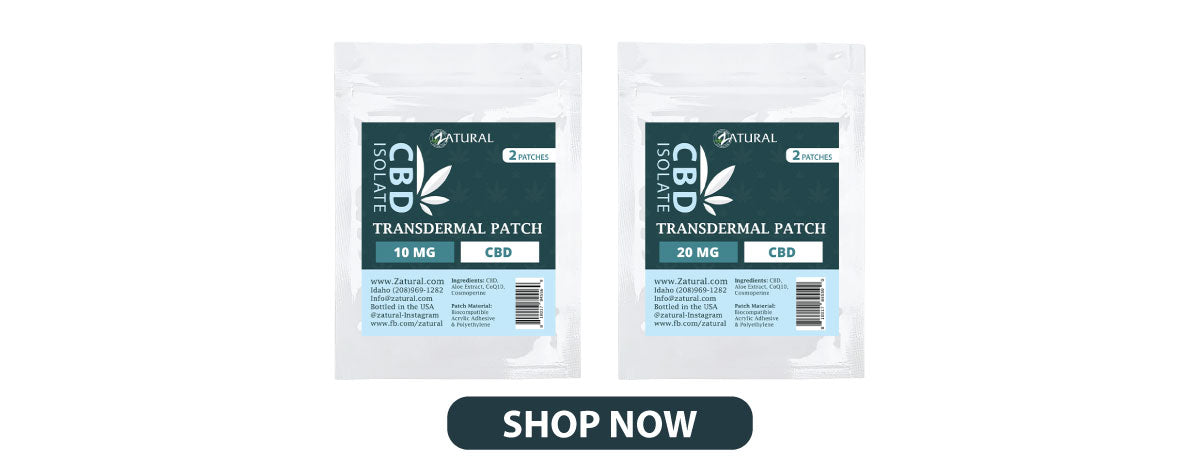
Zatural Transdermal CBD Infused Patch
Sum It Up!
Transdermal CBD Patches are another great option to help alleviate pain and inflammation, but in a localized area and without the need to take it orally if you dislike the natural flavor of CBD. Transdermal CBD and Topical CBD are not the same as they do not both enter the bloodstream. Topical works best for treating the skin.
Transdermal products work best when applied to a local area to treat pain and inflammation. Be sure that when you shop for a CBD product, remember they are not all created equal. Be sure you know the product before you buy to ensure it is a pure, quality product following the above steps.
For educational purposes, only
*FDA DISCLAIMER -These statements have not been evaluated by the FDA.
2 comments
Hi Lois, yes, you can take our CBD gummies and transdermal patch simultaneously. If you take these together, the patch will help target your back specifically, while the gummies help internally.
I normally take Zatural CBD Gummies Full Spectrum 1200 mg. Can you use the transdermal patch in conjunction with the gummies for added relief, such as my lower back?